The Giants of Architecture - Most Expensive Buildings Ever Made

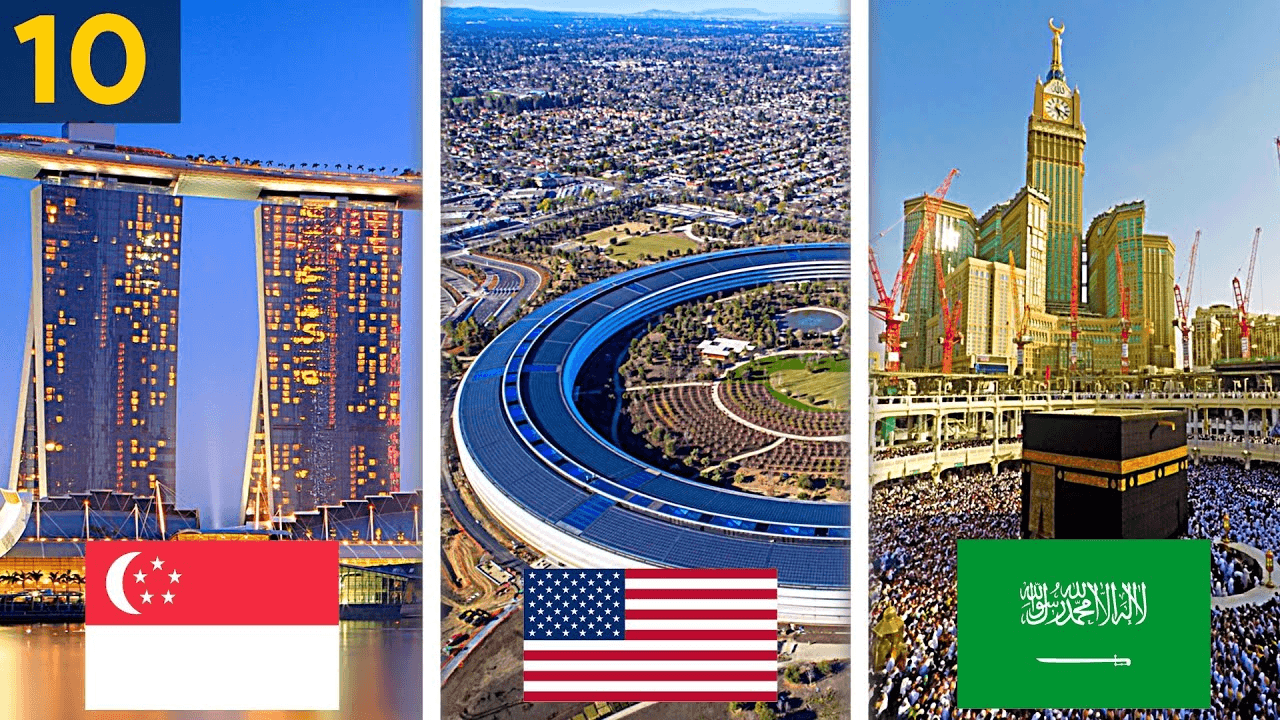
When we look at a city skyline, we often see more than just steel and glass; we see the physical manifestation of human ambition, economic power, and architectural genius. Over the last few decades, the scale of construction has shifted from "impressive" to "unfathomable." In the modern era, building a landmark is no longer just about height or aesthetics it is about creating an ecosystem.
For the US audience, accustomed to the towering skyscrapers of New York or the sprawling stadiums of Texas, the price tags on some of the world's newest structures might still come as a shock. While a typical high-end skyscraper in a major American city might cost a few hundred million dollars, the elite tier of global architecture has moved into the billions and in one case, over a hundred billion.
In this comprehensive exploration, we are counting down the top 10 most expensive buildings ever constructed. We will look at why they cost so much, the technology behind them, and how they have reshaped the cities they call home. From the high-tech "spaceship" of Silicon Valley to the spiritual heart of the Middle East, these are the giants of our world.
10. Burj Khalifa - The Vertical City ($1.5 Billion)
It might surprise many to find the world’s tallest building at the bottom of a "most expensive" list. Located in Dubai, United Arab Emirates, the Burj Khalifa stands at a staggering 2,717 feet. When it was completed in 2010, its $1.5 billion price tag was headline news.
In the world of ultra-expensive construction, $1.5 billion is actually a masterpiece of budgeting. The cost was kept relatively low because of the timeframe in which it was built and the specific focus on height rather than sprawling square footage or insanely expensive interior materials like gold plating (which we see later on this list).
The Burj Khalifa isn’t just a building; it’s an engineering triumph. To withstand the desert heat and high-altitude winds, engineers used a "buttressed core" design a hexagonal core reinforced by three wings. The exterior features over 26,000 glass panels designed to reflect the intense Arabian sun. It serves as a mixed-use "vertical city," containing luxury apartments, corporate suites, and the world-renowned Armani Hotel.
9. Palace of the Parliament - A Weighty Legacy ($4.64 Billion)
Moving to Bucharest, Romania, we find a building that represents a very different kind of ambition. The Palace of the Parliament is the heaviest building in the world and a relic of the late dictator Nicolae Ceaușescu’s reign.
With an inflation-adjusted cost of roughly $4.64 billion, this building is a massive labyrinth of marble, steel, and crystal. Construction began in 1984 and required the destruction of a significant portion of Bucharest's historic center, displacing thousands of residents.
The palace has 1,100 rooms and extends eight levels underground, including a nuclear bunker. It uses one million cubic meters of marble and 3,500 tons of crystal. Today, it houses the Romanian Parliament, but even now, roughly 70% of the building remains empty because the heating and lighting costs alone are millions of dollars per year. It stands as a cautionary tale of architectural excess.
8. Wynn Palace - Luxury Reimagined ($5.22 Billion)
In the gambling mecca of Cotai, Macau, the Wynn Palace takes luxury to a level that makes Las Vegas look modest. Completed in 2016 at a cost of $5.22 billion, it was designed to attract the world’s highest-rolling travelers.
The "Palace" isn't just a hotel; it’s a gallery. Steve Wynn spent over $100 million on art alone before the doors even opened, featuring pieces from Jeff Koons and rare Qing Dynasty porcelain. One of its most famous features is the SkyCab an air-conditioned gondola system that carries guests over a performance lake featuring dancing fountains.
The high cost is attributed to the incredibly high-end finishes. Every square inch of the 1,706 rooms is designed with opulent materials. In the mid-2020s, the Wynn Palace remains a benchmark for "integrated resorts," where the goal is to keep the guest inside the building for their entire vacation by providing every conceivable luxury under one roof.
7. The Cosmopolitan - The Jewel of the Las Vegas Strip ($5.33 Billion)
Returning to the United States, we land on the Las Vegas Strip. The Cosmopolitan, which opened in 2010, cost $5.33 billion to build. Unlike many older Vegas hotels that sprawl across huge plots of land, "The Cosmo" was built vertically on a very small footprint.
Because the site was only 8.7 acres, the developers had to build two towers of 60 stories each. This verticality increased construction costs significantly, as it required complex underground parking and high-tech elevator systems.
One of the most expensive interior features is the three-story Chandelier Bar, encased in two million glass crystals. The Cosmopolitan shifted the Vegas brand away from "themed" hotels (like pyramids or castles) toward "luxury lifestyle" hotels, focusing on high-end dining and nightlife, which justified its massive investment.
6. Apple Park - The "Spaceship" Headquarters ($6.08 Billion)
In Cupertino, California, sits perhaps the most technologically advanced office building ever made. Apple Park, the brainchild of Steve Jobs and architect Norman Foster, cost an estimated $6.08 billion.
Apple approached the construction of their headquarters like they approach an iPhone. The "Ring" building features the world’s largest panels of curved glass. The tolerances for the construction were unheard of contractors were often told that gaps between materials could not exceed a fraction of a millimeter.
The building is 100% powered by renewable energy, much of it from on-site solar panels. It features a natural ventilation system that allows it to go without air conditioning or heating for nine months of the year. The Steve Jobs Theater, a massive glass cylinder with a carbon-fiber roof that appears to float, cost over $100 million on its own. It is a testament to the wealth and perfectionism of Silicon Valley.
5. SoFi Stadium - The Future of American Sports ($6.33 Billion)
Located in Inglewood, California, SoFi Stadium is the most expensive sports venue ever built, with a total project cost of approximately $6.33 billion. Opened in 2020, it is home to both the Los Angeles Rams and the Los Angeles Chargers.
The reason for the high price tag is that SoFi is an "indoor-outdoor" entertainment complex. It features a translucent roof that covers the stadium, a pedestrian plaza, and a 6,000-seat performance venue.
The centerpiece is the Infinity Screen by Samsung a double-sided, 4K LED video board that sits above the field. It is the largest of its kind in the world, weighing 2.2 million pounds. Because the stadium is located near LAX airport, it had to be built partially underground to avoid interfering with flight paths, adding massive excavation costs to the budget.
4. Resorts World Sentosa - Singapore’s Playground ($6.74 Billion)
Singapore is home to some of the most expensive real estate on earth, and Resorts World Sentosa is a prime example. Located on an island off the southern coast, this integrated resort cost $6.74 billion.
The cost is distributed across a massive variety of attractions. It isn't just a casino; it includes a Universal Studios theme park, one of the world’s largest oceanariums (S.E.A. Aquarium), and several luxury hotels.
By the mid-2020s, Resorts World Sentosa has become a massive engine for Singapore’s tourism. The complexity of building a theme park and an underwater aquarium on an island contributed to the high costs, but the return on investment has been significant, bringing in millions of tourists annually.
3. Marina Bay Sands - The Icon of Singapore ($7.79 Billion)
Perhaps the most recognizable building in the world today, Marina Bay Sands (MBS) redefined the skyline of Singapore. Completed in 2010 for $7.79 billion, it consists of three 55-story towers connected by a massive roof terrace.
The most expensive and difficult part of the build was the SkyPark a 1,120-foot long cantilevered platform that sits on top of the three towers. It features a 478-foot infinity pool, the largest outdoor pool in the world at that height.
Aside from the engineering nightmare of lifting a park 650 feet into the air, the interior is filled with high-end luxury. It houses a massive convention center, a shopping mall with a canal running through it, and two state-of-the-art theaters. It is often cited as the most profitable standalone casino property in the world.
2. Abraj Al Bait (The Clock Towers) - Giant of the Desert ($19.5 Billion)
The jump in price from number 3 to number 2 is massive. Located in Mecca, Saudi Arabia, the Abraj Al Bait complex cost a staggering $19.5 billion.
The central tower features a clock face that is visible from 17 miles away. The clock alone is 141 feet in diameter. Atop the clock sits a massive crescent moon made of fiberglass and covered in gold leaf.
This complex was built to house the millions of pilgrims who visit Mecca for the Hajj. It can accommodate 100,000 people at a time. The high cost is due to the scale of the towers (the central tower is the 4th tallest in the world), the expensive materials used in the religious and luxury spaces, and the incredible logistical challenge of building in one of the most crowded areas on Earth.
1. The Great Mosque of Mecca - The $100 Billion Sanctuary ($115.2 Billion)
At the number one spot is a building that is in a category of its own. The Masjid al-Haram, or the Great Mosque of Mecca, has an estimated total value and expansion cost of $115.2 billion.
This isn't just one "building" in the traditional sense, but a massive religious complex that has been under continuous expansion for decades. The Saudi government has spent tens of billions in the 21st century alone to increase its capacity to hold over 2.5 million worshippers.
The costs come from the sheer scale of the marble work, the advanced cooling systems required for the outdoor plazas, the complex security and crowd-control technology, and the astronomical price of the land surrounding the site. It is the most sacred site in Islam, and the investment reflects its global importance. It is, by a massive margin, the most expensive structure on the planet.
What Does the Future Hold?
As we look at these ten buildings, a pattern emerges. Architecture has shifted from being about "shelter" to being about "experience." Whether it is Apple’s pursuit of the perfect workspace or Saudi Arabia’s goal of hosting millions of pilgrims, these price tags reflect a world where we are willing to spend billions to push the boundaries of what is possible.
As we move further into 2026 and beyond, we may see even higher numbers. With projects like "The Line" in Saudi Arabia currently under development, the $100 billion mark might soon have company.