Why Iran Should Be Your Next Adventure - Jewel of the Middle East

Iran the historical Persia is a land where history, tradition, and stunning natural beauty converge. Often misunderstood, this Middle Eastern nation is a global magnet for travelers seeking profound historical sites, vibrant cultural diversity, and landscapes of breathtaking contrast. From soaring mountains to scorching deserts, from magnificent, colorful mosques to the relics of the world's first great empires, Iran is a unique haven, a testament to the enduring human spirit and the meeting point of ancient civilization and modern resilience.
Despite decades of geopolitical challenges and economic sanctions since the 1979 Islamic Revolution, Iran has never ceased to be a place of warmth, hospitality, and cultural pride. Recent reports, factoring in data up to late 2025, suggest a significant resurgence in travel interest. Following periods of regional tension, a renewed global focus on tourism safety and stability has fueled optimism, with Iran seeing a substantial uptick in international visitors, showcasing its commitment to opening its doors to the world.
Let's embark on a journey through this timeless, historical landscape, where every city tells a story and every monument is a chapter in the epic of human civilization.
Iran's UNESCO World Heritage Sites
Iran boasts one of the world's most impressive collections of UNESCO World Heritage Sites, testifying to its 5,000-year history. These sites are the anchors of any unforgettable trip to this nation.
Naqsh-e Jahan Square, Isfahan - The Grand Stage
Naqsh-e Jahan Square (or Imam Square) in Isfahan is not just a square; it is a monumental urban masterpiece and one of the largest city squares globally. It is the heart of Safavid-era Persian and Islamic culture, a vast and aesthetically perfect space constructed in the early 17th century by Shah Abbas I.
The square, designated a UNESCO World Heritage Site in 1979, is framed by four architectural wonders, creating an unparalleled sense of balance and grandeur .
Imam Mosque (formerly Shah Mosque): Standing proudly on the south side, this mosque is a peerless example of Islamic architecture, famed for its intricate tilework, scale, and innovative use of acoustics.
Sheikh Lotfollah Mosque: Located on the east side, this mosque is unique as it lacks a minaret and a courtyard, originally serving as the private prayer hall for the Shah's court. Its creamy-yellow dome, which changes color throughout the day, is a study in aesthetic perfection.
Ali Qapu Palace: The six-story royal palace on the west side, which served as the official residence and a viewing platform for the Shah to watch polo and ceremonies held in the square below.
Qeysarieh Bazaar: The massive, historical market connecting the square to the ancient Silk Road trading routes in the north, offering a journey through time and commerce.
Naqsh-e Jahan Square is a living museum, celebrating the finest Islamic and Persian arts, making it a must-see for lovers of history, architecture, and religious heritage. The best time to visit is during the temperate seasons of spring (March–May) and autumn (September–November).
Persepolis, Fars Province - The City of the Persians
Persepolis, meaning "The City of the Persians" in Greek, was the ceremonial capital of the Achaemenid Empire, founded over 2,500 years ago. Today, it remains one of the world's best-preserved ancient ruins and Iran’s most important archaeological site.
The complex was initiated by Darius I in 518 BCE and later expanded by his successors, Xerxes I and Artaxerxes I. It served as the central hub for receiving foreign dignitaries and celebrating the New Year festival, Nowruz.
Architectural Grandeur: Persepolis is defined by its immense scale, monumental stone staircases, and the towering Gate of All Nations. The columns of the great Apadana Palace, once 72 feet high, and the elaborate bas-reliefs carved into the walls depicting imperial guards and tribute-bearers from across the empire, showcase the incredible sophistication of ancient Persian craftsmanship .
The Mark of History: The city was built on a vast terrace at the foot of a mountain slope, organized with geometric precision. In 330 BCE, Alexander the Great conquered Persia and famously burned part of Persepolis, scars of which are still visible today. Visiting Persepolis is to walk through the monumental remnants of an empire that once spanned three continents.
Takht-e Soleyman, West Azerbaijan: Throne of Solomon
Takht-e Soleyman (The Throne of Solomon) is a captivating historical and natural complex located in the highlands of West Azerbaijan. This UNESCO-listed site, over 3,000 years old, is considered one of the most enigmatic and visually stunning destinations in the Middle East.
The Center of Zoroastrianism: During the Sasanian Empire (3rd–7th century CE), Takht-e Soleyman was a crucial religious center, housing the "Azargoshasb" fire temple, one of the three most important perpetual fires of Zoroastrianism. Ruins of temples, walls, and water channels still dot the area.
The Enigmatic Lake: The site's centerpiece is a deep, dark blue, natural hot spring lake, connected to a subterranean volcanic source. Local legends hold that King Solomon (Nabi Soleyman) hid his vast treasures within its depths, giving the site its name. The lake's depth, estimated at over 112 meters, remains largely unexplored, adding to its mystery .
A Growing Destination: This site continues to draw significant interest from both domestic and international tourists, with approximately 70,000 visitors recorded in the most recent reporting period, drawn by its history, natural beauty, and the celebratory atmosphere during the spring Nowruz festival.
Unparalleled Natural Wonders - Landscapes of Extremes
Iran's geography is anything but monotonous. It is a land defined by dramatic contrasts, from lush northern forests to arid, scorching southern deserts.
The Hyrcanian Forests - A Living Fossil
Stretching across the northern provinces of Gilan and Mazandaran, bordering the Caspian Sea, the Hyrcanian Forests are a biological treasure trove. These forests are not just old; they are ancient, dating back 25–50 million years a true "living fossil" on the UNESCO World Heritage list .
Biodiversity Hotspot: This ecosystem is one of the most biodiverse regions in the world, stretching for approximately 850 kilometers. It hosts over 320 species of plants, with more than 80 species being endemic to the area, including rare, ancient varieties of oak, hornbeam, maple, and beech.
Wildlife Sanctuary: The forests provide a critical sanctuary for endangered species, including the Persian Leopard, wolves, brown bears, and various unique birds and amphibians.
A Hiker's Paradise: The Hyrcanian region, with its mix of mountains, valleys, waterfalls, and rivers, is an ideal destination for nature lovers and hikers, particularly during the mild, colorful seasons of spring and autumn.
Dasht-e Lut Desert - The Hottest Spot on Earth
The Dasht-e Lut (The Empty Desert) in southeastern Iran is one of the world's most mysterious, extreme, and starkly beautiful deserts. It is officially recognized as one of the hottest places on Earth, with recorded surface temperatures exceeding $80^\circ\text{C}$ ($176^\circ\text{F}$) in the summer.
The Kaluts (Rock Sculptures): The desert’s most famous feature is the Kaluts, vast yardang formations natural rock sculptures carved by the combined forces of wind and sand. These gigantic, canyon-like ridges and troughs resemble an alien city or the landscape of Mars, especially as their colors shift dramatically at sunrise and sunset.
An Uninhabitable Zone: Spanning over $51,800\text{ square kilometers}$, significant sections of the Lut are virtually devoid of any life (excluding some bacteria), making it one of the planet's most extreme environments.
Celestial Beauty: Its remote location and lack of light pollution make it an unparalleled destination for viewing the star-studded desert night sky a truly once-in-a-lifetime experience for adventurers.
Mount Damavand - Iran's Majestic Peak
Dominating the landscape of Northern Iran is Mount Damavand, a magnificent stratovolcano and the highest peak in the Middle East, soaring to $5,610\text{ meters}$ ($18,406\text{ feet}$).
A National Icon: Damavand is not only a natural wonder but also a deeply significant national symbol of Iranian culture and mythology. Its snow-capped summit creates a stunning contrast with the green foothills below during the summer months, which are blanketed with wildflowers.
Adventure Tourism: The mountain is a mecca for mountaineers and nature enthusiasts globally. It offers challenging yet rewarding climbs, with several thermal hot springs at its base, such as Lāreh and Reineh, providing post-hike relaxation.
Ecosystem: The surrounding high forests and valleys are home to rare wildlife, including wild goats, sheep, eagles, and the white wolf, alongside diverse medicinal plants
Badab-e Surt, Northern Iran - Travertine Terraces
Hidden away in the mountainous region of Mazandaran Province, Badab-e Surt is a breathtaking natural formation composed of cascading travertine terraces stepped mineral springs formed over thousands of years.
Color Palette: The unique colorations ranging from striking red, yellow, orange, and gold are due to the high concentration of mineral deposits, particularly iron oxide and sulfur, in the water. The hues are most intense during the golden hours of sunrise and sunset .
Secluded Beauty: Located near the village of Orost, about $95\text{ km}$ south of Sari, the site’s relative seclusion adds to its peaceful, mysterious allure, making it a perfect spot for photography and quiet contemplation amid untouched nature.
Cities and Cultural Heritage - A Tapestry of Civilizations
Iran’s cities are repositories of history, showcasing millennia of architectural innovation and diverse cultural traditions, from royal palaces to desert urbanism.
Yazd - The City of Windcatchers
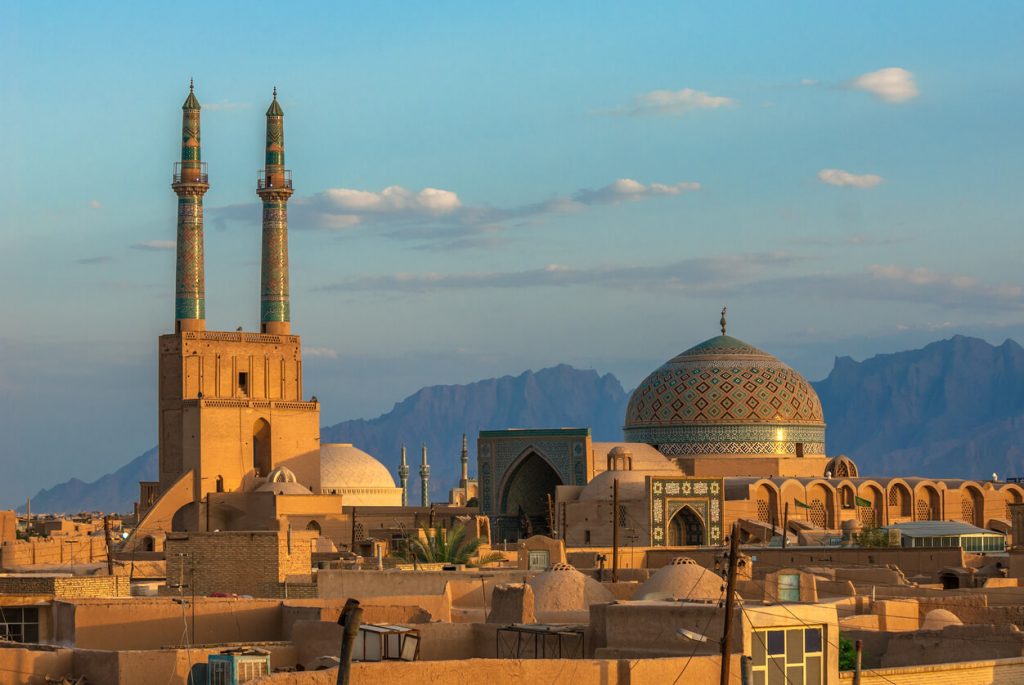
The city of Yazd, located in the central desert region, is a living relic of Persian civilization, celebrated for its ancient architecture, unique desert lifestyle, and its deep connection to the Zoroastrian faith. The old city is one of the oldest on Earth, estimated to be nearly 5,000 years old.
Architectural Marvels: Yazd is famously recognized by its Badgirs (Windcatchers) ancient Persian architectural elements designed to naturally cool houses by drawing air down and passing it over water, a brilliant example of sustainable desert engineering.
Zoroastrian Heart: Yazd remains the spiritual center of Zoroastrianism, a monotheistic religion predating Islam. Key sites include:
Yazd Fire Temple (Atashkadeh): Home to a sacred flame said to have been continuously burning for over 1,500 years.
Chak Chak: A mysterious, sacred Zoroastrian pilgrimage temple built into the side of a mountain.
Towers of Silence (Dakhmeh): Once used for the ancient Zoroastrian practice of leaving the deceased exposed to the elements, these towers now stand open to visitors, offering a glimpse into profound cultural traditions.
Yazd’s harmonious blend of ancient traditions and modern life makes it an utterly unique historical travel experience.
Golestan Palace, Tehran - The Royal Showcase
Located in the heart of Tehran, the Golestan Palace (meaning "The Flower Garden") is a historical and cultural gem, reflecting the royal splendor of Persia's past. This UNESCO World Heritage Site is an essential visit for understanding the transition to modern Iran.
A Fusion of Styles: The palace complex is a stunning showcase of architectural synthesis, blending traditional Persian craftsmanship (especially its breathtaking tilework and mirror halls) with Neo-Classical European design influences, primarily incorporated during the Qajar Dynasty (1794–1925).
Witness to History: Though its origins date back to the Safavid era (1501–1736), the palace was primarily enhanced and served as the seat of the Qajar monarchy for over 200 years. It was the site of the coronation of the last two Pahlavi Shahs. Its opulent halls and museums draw an impressive number of visitors annually, averaging $1.2\text{ million}$, eager to explore its royal history.
Nasir al-Mulk Mosque, Shiraz - The Pink Mosque
In the historic city of Shiraz lies the Nasir al-Mulk Mosque, widely regarded as one of the most visually stunning mosques in the world. Locally, it is affectionately known as the "Pink Mosque" or the "Rainbow Mosque" due to its unparalleled use of color.
A Play of Light and Color: The mosque's true magic unfolds at sunrise. Its vast expanse of stained-glass windows transforms the interior into a kaleidoscope of light and color, casting brilliant geometric patterns across the Persian carpets, walls, and pillars .
Exquisite Design: Completed in 1888, the mosque's exterior is adorned with intricate tiles in saffron, pink, blue, and green. The interplay of Islamic art, masterful architecture, and light creates an almost ethereal, fairy-tale atmosphere—a unique sensory experience unlike any other religious site.
Unique Villages and Experiences
Beyond the well-known cities and historical monuments, Iran holds pockets of remarkable living history in its smaller, often remote communities.
Kandovan Village, East Azerbaijan - The Troglodyte Homes
The village of Kandovan in East Azerbaijan is one of the world’s most fascinating troglodyte (cave dwelling) communities. Its homes are carved directly into naturally formed, cone-shaped volcanic rock formations called karans.
Geological Origins: These unique formations were created by volcanic ash and debris from the nearby Sahand volcano, which, over millennia, were shaped by wind and erosion into distinct, habitable cones.
Living History: The village is believed to have been continuously inhabited for at least 700 years, with some homes reaching up to seven stories high within the stone.
Accommodation Trend: Kandovan has embraced tourism by offering several cave hotels, including the luxurious Kandovan Rock Hotel, allowing visitors a truly immersive, once-in-a-lifetime opportunity to sleep inside the mountain.
Embracing the Iranian Experience
Iran's appeal lies in its extraordinary depth and variety. From the towering columns of Persepolis and the sacred fires of Takht-e Soleyman to the lush, ancient Hyrcanian Forests and the alien-like Kaluts of the Dasht-e Lut, Iran offers a travel narrative that is both epic and deeply personal.
The country's blend of ancient Persian grandeur, sophisticated Islamic art, and rugged natural beauty, underpinned by the legendary hospitality of its people, solidifies its status as one of the world's most compelling destinations. It is a nation actively committed to safeguarding its heritage while inviting the world to witness its breathtaking reality.
Now is the time to look beyond the headlines and explore this vibrant, historically rich, and welcoming land.